About 39 minutes
The Snowbank Orbit — Inside the Classic
Space Future
8,919 recorded words. 0 minutes difference from this book's estimate.
View Gutenberg source #61243
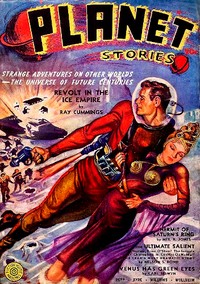
For Venus Has Green Eyes — Reading Companion, the stored edition analysis reports 8,957 words, 39 min estimated reading time, and 1 detected text section.
The text analysis averages about 12.8 words per sentence, while the detected sections provide another way to judge how the source is divided.
Project Gutenberg metadata also associates the work with “Science fiction,” connecting these edition facts with the source record’s subject description.
Explore this collection
These alternatives are selected using recorded categories and estimated reading time.
About 39 minutes
Space Future
8,919 recorded words. 0 minutes difference from this book's estimate.
View Gutenberg source #61243About 39 minutes
Space Future
8,868 recorded words. 0 minutes difference from this book's estimate.
View Gutenberg source #62351About 38 minutes
Space Future
8,559 recorded words. 1 minutes difference from this book's estimate.
View Gutenberg source #61146Search stored excerpts and compare books → Choose by your preferences →
Choices use stored catalog measurements. Estimates vary with reading speed. A shared category is a catalog label, not a claim that two books have the same argument or literary quality.
Search reads excerpt text stored with this catalog and links to its associated Gutenberg record. The connection is stored in the site database; this tool does not recheck that every excerpt is word-for-word identical to that external record. Excerpt search does not cover every chapter and does not verify historical publication dates.
Catalog snapshot checked: 2026-09-25. Coverage: 99 public books, 99 available source excerpts.
Read the complete public-domain text at its original source.
Read on Project GutenbergThe story opens with a forty-day drunk, not a spaceship launch. Charlie Mead and Flip Miller drink loku in a rusty shack while Venusian fog swirls through the door. Flip's reasons for drinking—a lost fortune, a dubious map—are laid out in a single, sardonic sentence: “To hell with the following, I.M.C., radios, fuel tanks, and this soggy planet of yours, Venus!” The voice is immediate, colloquial, and self-mocking.
From the first paragraphs, the narrative establishes a pattern: Flip's wild schemes (marooned on Pallas, poker fortune lost, map won as stakes) are recounted with a shrug. The prose treats disaster as routine. The setting—mud, fog, rust, and a billion-dollar mine buried in asphalt—is sketched with concrete, sensory details. A reader should note how quickly the story moves from character introduction to plot engine: the mine exists, the map is real, and the trouble is already in motion.
Flip Miller is introduced not through description but through action and dialogue. Charlie calls him a man of “wild-goose chases and wilder ideas.” The narrator reports his past misadventures—falling out of a plane while looking for diamonds, winning and losing a fortune—with a deadpan brevity that matches Flip's own attitude. When Charlie laughs at his misfortunes, Flip does too. This self-deprecating humor is a key tonal marker.
The prose style is lean, favoring short sentences and concrete verbs: “Flip leaned back against the bundles of fur and held up four fingers.” There is little interiority; emotions are shown through physical action. When Flip realizes the rope binding him can be cut on a rusty edge, he “almost turned over his chair with excitement.” The narration stays external, letting the reader infer his panic and determination. This technique keeps the pace fast and aligns the reader with Flip's improvisational mindset.
Flip's escape from Captain Vixen's men hinges on a mundane observation: the rope is looped through rust-eaten holes. He seesaws it against the metal, a plan that depends on the decay of the setting. Later, when he sabotages the ship, he uses mud—the same mud that has caked him throughout the story—to clog a power jet. The solution is both crude and clever, born from the environment.
The narrative emphasizes process over planning. Flip “kept at his work” sawing the rope; he “scooped up a handful of mud, stuffed it into the five-inch opening.” There is no grand strategy, only immediate, physical responses. The text even undercuts his cleverness: “But he would never know it if they did” (if the jets ignited while he worked). This willingness to risk fatal consequences for a chance at escape defines the pulp hero's code. Readers should watch how each obstacle is met with a makeshift, material solution rather than abstract reasoning.
Venus in this story is not a romanticized jungle but a soggy, corrosive swamp. The shack has “rusty holes in the wall”; the wind whistles through them. The mine is “fused with asphalt and deep in the mire, thousands of miles from nowhere.” The planet itself seems to resist human presence. Even the native fauna—the veedle, a creature that scurries across Flip's foot—is a potential hazard: if one crawls into a muffler tube, it could explode.
The setting is not backdrop but antagonist. The mud that Flip uses to sabotage the ship is the same mud that has made his journey miserable. The cold that seeps through the door at night is a constant threat. The story's physical details—the “five-inch opening” of a power jet, the “rusty edges” of a hole—ground the action in a tangible, hostile world. This attention to environmental texture gives the pulp adventure a gritty, tactile realism.
The excerpted portions show a careful alternation between setup and payoff. The opening drunk scene introduces the mine and Flip's character; the middle section presents capture and escape; the later excerpt escalates to sabotage and confrontation. Each scene builds on the previous one, with physical details (the rope, the mud, the ship's door opening) creating micro-cliffhangers.
The narrative often withholds information to heighten tension. When Flip hears people moving inside the ship, the text does not describe their conversation. When he drops down beside the hull, the reader shares his limited perspective. The prose uses short paragraphs and frequent line breaks to accelerate the rhythm during action sequences. This structural choice mirrors Flip's own focus on the immediate moment: “Flip Miller's mind never strayed far from the present.” Readers should note how the story's pacing reflects the protagonist's reactive, moment-to-moment consciousness.
This editorial note has traced how the opening, middle, and later excerpts establish a consistent voice, a resourceful protagonist, and a physically oppressive setting. The story rewards attention to small details—the rust, the mud, the veedle—that become tools or threats. A first reading might focus on how Flip's improvisations emerge from the environment, and how the prose style mirrors his impulsive, present-tense thinking. The excerpts suggest a tightly plotted adventure where every element of the setting is potentially useful or dangerous.
I’ve always admired how Miller, sobering up beside that sabotaged engine, finds his way through sheer stubborn wit. It reminds me of another quiet struggle against frozen inevitability, where hope is a small, warm defiance. Revolt in the Ice Empire — Themes and Context holds that same patient ember, I think—a kinship of grit, not glory.
Use these questions to collect your thoughts before moving on.