About 56 minutes
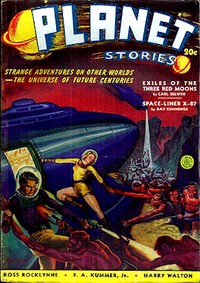
Exiles of the Three Red Moons — A Reader’s Guide
Space Future
12,761 recorded words. 2 minutes difference from this book's estimate.
View Gutenberg source #61752

Before opening The Star-Master — Text and Context, the edition data offers a quick orientation: 13,303 words, 58 min estimated reading time, and 2 detected text sections.
The text analysis averages about 12.7 words per sentence, while the detected sections provide another way to judge how the source is divided.
Project Gutenberg metadata also associates the work with “Science fiction,” connecting these edition facts with the source record’s subject description.
Explore this collection
These alternatives are selected using recorded categories and estimated reading time.
About 56 minutes
Space Future
12,761 recorded words. 2 minutes difference from this book's estimate.
View Gutenberg source #61752About 60 minutes
Space Future
13,732 recorded words. 2 minutes difference from this book's estimate.
View Gutenberg source #61958About 56 minutes
Space Future
12,767 recorded words. 2 minutes difference from this book's estimate.
View Gutenberg source #62186Search stored excerpts and compare books → Choose by your preferences →
Choices use stored catalog measurements. Estimates vary with reading speed. A shared category is a catalog label, not a claim that two books have the same argument or literary quality.
Search reads excerpt text stored with this catalog and links to its associated Gutenberg record. The connection is stored in the site database; this tool does not recheck that every excerpt is word-for-word identical to that external record. Excerpt search does not cover every chapter and does not verify historical publication dates.
Catalog snapshot checked: 2026-09-25. Coverage: 99 public books, 99 available source excerpts.
Read the complete public-domain text at its original source.
Read on Project GutenbergThe narrative opens with Arthur Frane's self-deprecating confession that he is "extolled as a hero although I did nothing except try to keep from getting killed," immediately establishing a first-person voice that blends self-awareness with action. The story's structure hinges on movement between sharply contrasting environments: from an Adirondack forest where Frane accidentally shoots a Venusian girl, to the storm-wracked Venusian wilderness, and finally to a ruined amphitheater littered with empty weapon boxes. These transitions are marked by sensory details—twilight deepening into purple, a lurid greenish-yellow sky, and the eerie orange luminosity of giant trees—that anchor the reader in each new scene.
Frane introduces himself as a wealthy twenty-six-year-old who "left to spend my income and become a dawdler," a characterization that colors his account of the Venus crisis. His narration is punctuated by asides to the reader: "Do not envy me for that" and "I'm much obliged" after the newscasters call him "Viking-like and handsome as a god." This self-aware tone creates a conversational intimacy, but it also serves a structural purpose—Frane is recounting events already known to his audience, so the tension lies not in what happens but in how he experienced it. The opening hunting scene, with its accidental shooting of Venta, establishes his fallibility and sets the plot in motion without grandiosity.
Light sources recur as markers of danger and discovery. The violet pencil-flash that nearly kills Venta is a weapon of casual violence; later, the "lurid greenish-yellow storm-clouds" and "faint orange luminosity" of Venusian trees create a palette of sickly illumination. Storms function as both obstacle and atmospheric device: a "roar of wind" cracks branches and delays the search, while the "turgid dimness" of the broken city amplifies the sense of decay. These weather patterns are not mere backdrop—they dictate the pacing of the chase, forcing Frane and Jim to wait out lulls and navigate littered terrain. The storm's lessening is noted with relief, but the persistent gloom keeps the mood oppressive.
Meeta, the ten-inch elfin creature who perches on Frane's shoulder and flies ahead to scout, serves as both a narrative compass and a source of unexpected agency. Her humming forays and sudden cries—"Look! He is over there!"—direct the reader's attention and break up long passages of description. In the climactic fight with Jahnt, Meeta physically intervenes, striking the villain in the face and retrieving the dropped knife. This moment inverts the expected hierarchy: the small, seemingly helpless guide becomes the decisive factor. Her presence also reinforces the story's movement between scales—from the vast forest to the intimate space of a rocky niche—and her ability to fly allows the narrative to shift perspective rapidly.
The search for the hidden weapons drives the second half of the excerpt, culminating in a scene of anticlimax: the boxes are "broken open; empty." This discovery, delivered in short, gasping dialogue—"Gone!" Jim gasped. "That damned Jahnt!"—reverses the expected trajectory of the rescue mission. The ruined amphitheater, described as "a place of the ghosts of Venus' past," becomes a stage for betrayal and violence. Jahnt's ambush and death, with Meeta's intervention, resolve the immediate threat but leave the larger question of the weapons' whereabouts unanswered. The structure here mirrors the earlier hunting scene: a sound in the underbrush, a sudden confrontation, and a shift from pursuit to survival.
Readers should attend to how Cummings uses Frane's retrospective narration to create suspense despite the outcome being known. The interplay between the human characters and the Venusian environment—particularly the way storms and ruins dictate the pace of action—offers a model of pulp adventure that prioritizes atmosphere over exposition. The incomplete resolution of the weapon cache invites speculation about what the full story might reveal, but the excerpts themselves reward attention to the small, precise details of setting and movement.
I found myself thinking lately about how Arthur Frane’s need to trust Meeta among those shifting Venusian forests mirrors my own quiet unease reading about societal castoffs in Colony of the Unfit — Context and Discussion. Both stories made me wonder who we choose to follow when the path itself disappears. Strange how rescue and abandonment circle the same shadow.
Save your reaction, strongest insight, and memorable passage.