About 56 minutes
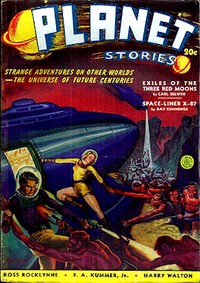
Exiles of the Three Red Moons — A Reader’s Guide
Space Future
12,761 recorded words. 0 minutes difference from this book's estimate.
View Gutenberg source #61752
The catalog record for Space Oasis — A Closer Reading provides practical reading context through 12,767 words, 56 min estimated reading time, and 2 detected text sections.
The text analysis averages about 13.1 words per sentence, while the detected sections provide another way to judge how the source is divided.
Project Gutenberg metadata also associates the work with “Science fiction,” connecting these edition facts with the source record’s subject description.
Explore this collection
These alternatives are selected using recorded categories and estimated reading time.
About 56 minutes
Space Future
12,761 recorded words. 0 minutes difference from this book's estimate.
View Gutenberg source #61752About 55 minutes
Space Future
12,562 recorded words. 1 minutes difference from this book's estimate.
View Gutenberg source #61097About 54 minutes
Space Future
12,375 recorded words. 2 minutes difference from this book's estimate.
View Gutenberg source #62075Search stored excerpts and compare books → Choose by your preferences →
Choices use stored catalog measurements. Estimates vary with reading speed. A shared category is a catalog label, not a claim that two books have the same argument or literary quality.
Search reads excerpt text stored with this catalog and links to its associated Gutenberg record. The connection is stored in the site database; this tool does not recheck that every excerpt is word-for-word identical to that external record. Excerpt search does not cover every chapter and does not verify historical publication dates.
Catalog snapshot checked: 2026-09-25. Coverage: 99 public books, 99 available source excerpts.
Read the complete public-domain text at its original source.
Read on Project GutenbergThe story opens with narrator Chet Wallace scanning a casualty bulletin board on Enterprize Asteroid, a scene that immediately establishes the cost of asteroid mining. The list is clinical: "Joe Tiffany—dead—space armor defect" and a long column of men hospitalized for "mental" issues, marked with ditto lines. Gallun’s prose is lean and unsparing, focusing on the physical toll—"space blindness," "cosmic rays seeped through his leaded helmet"—and the psychological erosion caused by "the utter silence, and the steady stars, and the blackness." This is not a romanticized frontier; it is a place where men are broken by weightlessness and isolation.
Gallun’s word choices consistently emphasize harm and depletion. The narrator describes miners as "shoving from one drifting, meteoric lump to another" and "chipping at those huge, grey masses with a test hammer that makes no sound." The verbs are mechanical, repetitive. Casualties are listed with bureaucratic brevity—"laconic tag added at the top— hospitalized — mental." The phrase "ditto marks saved the trouble of retyping" underscores how dehumanizing the system is. Even the protagonist’s reaction to a friend’s breakdown is muted: "It gave me a little jolt, and a momentary lump somewhere under my Adam's Apple." The body registers trauma, but the voice stays flat, as if emotion itself is a luxury the environment cannot afford.
The first-person narration by Chet Wallace is deliberately unadorned, but his observations carry a weary authority. He notes that Ted Bradley, once "keen and sure of himself," has been changed "forever" by a year among the asteroids. The narrator does not editorialize; he reports. Yet his choice of details—the "blackness of the shadows, like the fangs of devils in the blazing sunshine"—reveals a mind struggling to articulate horror through simile. When antagonist Norman Haynes appears, his dialogue is clipped and calculating: "Set the robot control for gradually increasing power, so that we'll have time to get away." The contrast between Chet’s worn, observational tone and Haynes’s cold, commanding speech heightens the tension without overt commentary.
The asteroid environment is rendered through sensory deprivation. Sound is absent: the test hammer "makes no sound in the voidal vacuum." Gravity is a variable threat—Haynes threatens to increase it to "fifty gravities," which would mean "a heart stopped by the load of the blood it tried to pump." The underground vault where the gravity generator is housed is described as a "busy cavern of metal giants, green light, and glinting crystal," a rare moment of vivid color that contrasts with the grey, silent surface. Gallun uses the setting not as backdrop but as an active force: the pressure at depth makes breathing difficult, and the generator’s hum grows "shrill" as it powers up. The environment itself becomes a weapon.
Dialogue in the excerpts is sparse and functional, often serving to expose hierarchy. Haynes speaks in commands: "Break the manual controls, so that no readjustments can be made." His henchmen reply with minimal acknowledgment. The alien character Geedeh speaks in short, urgent bursts: "Courage!" and "Many birds with one stone!"—the latter echoing Haynes’s own phrase, suggesting a grim mimicry. When the surface phone rings, the lookout’s panicked report—"There's a bunch of specks to the right of the sun"—is met with Haynes’s cool calculation: "We'll use gravity on them, too!" The exchanges reveal who holds power and who reacts, with the narrator often reduced to internal observation rather than participation.
Readers should attend to how Gallun balances the physical specifics of mining—ore types like radium and tantalum, the premium on payload mass—with the psychological weight of isolation. The story’s tension derives not from space battles but from the slow, crushing pressure of environment and authority. The first-person voice, limited to what Chet sees and feels, makes the reader complicit in his helplessness. Watch for how the author uses technical jargon not as ornament but as a marker of the characters’ entrapment in a system that reduces men to ditto marks.
Years among the stacks, I’ve watched men like Gallun’s asteroid miners—worn down by silence and stone—carry a weary dignity. There is a kindred spirit in that other volume, one that too understands the weight of a single stubborn purpose. The Avenger — Key Ideas to Explore holds a similar ache, a lonely resolve. It’s a quiet kinship, felt best in the hush between the shelves.
Your answers remain private and are stored only in this browser.