About 69 minutes
Citadel of Lost Ships — Reading Notes
Space Future
15,692 recorded words. 1 minutes difference from this book's estimate.
View Gutenberg source #62316
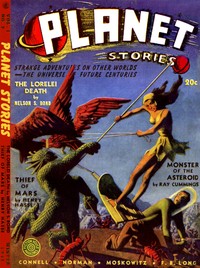
The source record for The Lorelei Death — Story, Setting & Ideas measures this digital text at 15,960 words, 1 hr 10 min estimated reading time, and 2 detected text sections.
The text analysis averages about 13.0 words per sentence, while the detected sections provide another way to judge how the source is divided.
Project Gutenberg metadata also associates the work with “Science fiction,” connecting these edition facts with the source record’s subject description.
Explore this collection
These alternatives are selected using recorded categories and estimated reading time.
About 69 minutes
Space Future
15,692 recorded words. 1 minutes difference from this book's estimate.
View Gutenberg source #62316About 74 minutes
Space Future
16,817 recorded words. 4 minutes difference from this book's estimate.
View Gutenberg source #63432About 65 minutes
Space Future
14,923 recorded words. 5 minutes difference from this book's estimate.
View Gutenberg source #61380Search stored excerpts and compare books → Choose by your preferences →
Choices use stored catalog measurements. Estimates vary with reading speed. A shared category is a catalog label, not a claim that two books have the same argument or literary quality.
Search reads excerpt text stored with this catalog and links to its associated Gutenberg record. The connection is stored in the site database; this tool does not recheck that every excerpt is word-for-word identical to that external record. Excerpt search does not cover every chapter and does not verify historical publication dates.
Catalog snapshot checked: 2026-09-25. Coverage: 99 public books, 99 available source excerpts.
Read the complete public-domain text at its original source.
Read on Project GutenbergThe opening pages of The Lorelei Death introduce Chip Warren, Syd Palmer, and Salvation Smith aboard the spaceship Chickadee II with a tone that is deliberately light and bantering. Chip fusses over a necktie, Syd mocks his vanity, and Salvation offers a biblical quip about Joseph's coat of many colors. This domestic comedy is undercut by Salvation's warning about the lawless Belt region, and Syd's reference to a man named Dougal MacNeer who fell victim to local entertainers. The contrast between the crew's casual mood and the dangers they soon face is sharp, and the dialogue reveals character through idiom—Chip's slang, Syd's engineering focus, Salvation's religious framing—rather than exposition.
Dr. Blaine's invention, the omniwave, is central to the story's conflict. It can superimpose sound and light waves onto any receptor, transmitting across a range of 30 kilocycles down to 4,000 Angstrom units. The crew encountered its effect when Alison's face and voice appeared on every wavelength of their perilens, even with audio off, making blind flying inevitable. This is not a generic space hazard but a specific technological trap. Blaine intended the omniwave for benevolent communication, but it has been co-opted by Jordan's gang to lure ships to destruction. The device's description is technical but plausible within the story's 1941 context, and its misuse drives the plot without requiring the reader to understand every detail.
Dr. Blaine reveals that the asteroid on which the crew has crashed is not a natural body but a hollowed-out, rocket-propelled vessel. He explains that he installed jets at one-eighth mile intervals, fed from a central explosion chamber, and created living quarters and control chambers using atomblasts. The purpose was to build a lightship massive enough to withstand meteor impacts and rogue asteroids, reducing the collision risk that claims over a hundred ships annually. This concept transforms a familiar space hazard—asteroids—into a setting and a vehicle. The revelation is delivered as a confession, with Blaine lamenting that his work has been perverted, adding a moral dimension to the technological marvel.
The excerpts show a crew defined by their speech patterns. Chip Warren is brash and colloquial, using phrases like "give me a pain in the pants" and "li'l' Chip won't be home till the wee, sma' hours." Syd Palmer is the pragmatic engineer, more interested in the ship than in parties. Salvation Smith speaks in biblical allusions and sober warnings, but his description as "not one of those milk-and-water missionaries" who turns the other cheek hints at a more active role. Their banter establishes camaraderie and individual traits without lengthy backstory. When they meet Dr. Blaine, his formal, explanatory dialogue contrasts with the crew's casual tone, marking him as an outsider. These vocal differences create a textured social world within the pulp adventure frame.
Readers should pay attention to how Bond uses technical jargon—like "ekalastron" cargo, "perilens," and "forejetted"—to build a sense of a lived-in spacefaring culture. The story's title references the Lorelei myth, but the excerpts do not yet show how that siren lure operates beyond the omniwave. The incomplete text leaves questions about Jordan's gang, Alison's role, and whether the asteroid-ship will be used for redemption or destruction. Approach the work as a period piece where scientific speculation serves both plot and moral inquiry.
What stayed with me about the Chickadee’s silent, drifting menace wasn’t the action, but how a single invention could quietly haunt a person’s conscience. I felt that same ache reading Assignment on Venus — Story, Setting & Ideas — not the plot, exactly, but the way that story’s unease lingers in the soft corners of your thinking for days.
Build a private reading journal entry for this title.