About 36 minutes
Assignment on Venus — Story, Setting & Ideas
Space Future
8,144 recorded words. 0 minutes difference from this book's estimate.
View Gutenberg source #62348
The source record for The Avenger — Key Ideas to Explore measures this digital text at 8,130 words, 36 min estimated reading time, and 1 detected text section.
The text analysis averages about 14.8 words per sentence, while the detected sections provide another way to judge how the source is divided.
Project Gutenberg metadata also associates the work with “Science fiction,” connecting these edition facts with the source record’s subject description.
Explore this collection
These alternatives are selected using recorded categories and estimated reading time.
About 36 minutes
Space Future
8,144 recorded words. 0 minutes difference from this book's estimate.
View Gutenberg source #62348About 37 minutes
Space Future
8,465 recorded words. 1 minutes difference from this book's estimate.
View Gutenberg source #61895About 35 minutes
Space Future
7,909 recorded words. 1 minutes difference from this book's estimate.
View Gutenberg source #63477Search stored excerpts and compare books → Choose by your preferences →
Choices use stored catalog measurements. Estimates vary with reading speed. A shared category is a catalog label, not a claim that two books have the same argument or literary quality.
Search reads excerpt text stored with this catalog and links to its associated Gutenberg record. The connection is stored in the site database; this tool does not recheck that every excerpt is word-for-word identical to that external record. Excerpt search does not cover every chapter and does not verify historical publication dates.
Catalog snapshot checked: 2026-09-25. Coverage: 99 public books, 99 available source excerpts.
Read the complete public-domain text at its original source.
Read on Project GutenbergThe story opens with a striking image: Peter Karson is dead, blood still oozing from his crushed face, while the narrator observes the silent machinery and feels an indefinable emptiness. This visceral scene sets the tone for a narrative that moves between the narrator's present and Karson's past, exploring the consequences of creating a superman to fight alien invaders.
The structure alternates between the narrator's cold, logical observations and Karson's emotional diary entries, revealing a gradual transformation from human to something else. Recurring images of tears, mirrors, and the void emphasize the psychological cost of the mission.
The narrative begins not with action but with stillness: Peter Karson sits dead in a chair, blood dripping into a pool. The narrator, later revealed to be the superman Robert, describes a void inside himself—neither emotion nor logic, but an emptiness that cannot be filled. This void is a key image, recurring when Robert touches his cheek and finds a tear, a physical manifestation of something he cannot name. The machinery around them is silent, dead, mirroring the internal state. The stars outside, once friendly, become cold and alien, signaling a shift in perspective. This opening establishes the story's focus on internal states and the aftermath of creation, rather than the action of the mission itself.
Peter Karson's diary reveals his journey: he builds a citadel and a ship called The Avenger, then leaves Earth to mutate in space. The diary entries are fragmented, showing his physical decay—he smashes mirrors when changes become evident—and his psychological isolation. He destroys most of the mutated embryos, but spares one: the millionth mutation, Robert. The diary's language shifts from technical precision to despair, as Karson repeats a line from an old film: “They'll come back—but not as boys,” which he twists into a litany of monstrous possibilities. This section uses the diary as a structural device to compress years of suffering into a few pages, emphasizing the slow, relentless nature of the transformation.
When Robert confronts Peter, the dialogue reveals their reversed roles: Robert is the superman, superior in intellect, while Peter is the flawed creator. Peter's eyes glow in misshapen sockets, and Robert notes his own lack of imperfections. The scene is set against a window with blazing galaxies, a reminder of the cosmic scale of their endeavor. Yet the conversation is intimate, focused on the personal cost. Peter admits he has changed but little, his lank gray hair and excrescences of flesh marking his degeneration. Robert's calm, logical tone contrasts with Peter's nervous energy, highlighting the emotional distance between them. This section uses the physical setting—the ship, the window—to underscore the isolation and the weight of their shared history.
Throughout the story, specific images recur to tie the narrative together. The tear that rolls down Robert's cheek in the opening is echoed in Peter's diary when he smashes mirrors to avoid seeing his own transformation. The void that Robert feels is mirrored in the emptiness of the ship and the silent machinery. The stars, initially friendly, become alien, reflecting the characters' changed perceptions. These images are not merely decorative; they structure the emotional arc, moving from shock to acceptance to a kind of hollow resolution. The story's power lies in how these concrete details—blood, tears, shattered glass—carry the weight of abstract concepts like identity and purpose, grounding the science fiction premise in human (or post-human) experience.
Readers should pay attention to the way the story uses the diary as a frame within a frame, and how the narrator's voice shifts from detached observation to something more personal. The ending, though not fully excerpted, likely returns to the opening scene, completing a circular structure. The title The Avenger may be ironic, as the focus is less on vengeance and more on the consequences of creation and the nature of humanity.
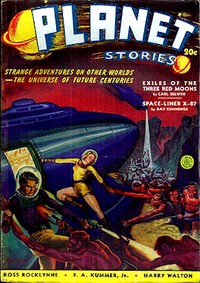
The scientist in The Avenger wept when his perfect creation became a stranger, a sorrow I understand. That ache of watching something you shaped drift into its own lonely orbit. Curiously, a quieter echo of that isolation lives in Exiles of the Three Red Moons — A Reader’s Guide, where exile isn’t distance but a question of who remains when the looking stops.
Your answers remain private and are stored only in this browser.