About 101 minutes
The War-Nymphs of Venus — Story, Setting & Ideas
Space Future
23,104 recorded words. 0 minutes difference from this book's estimate.
View Gutenberg source #61884
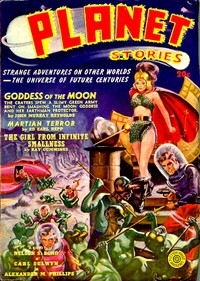
The catalog record for Goddess of the Moon — Inside the Classic provides practical reading context through 23,034 words, 1 hr 41 min estimated reading time, and 2 detected text sections.
The text analysis averages about 16.4 words per sentence, while the detected sections provide another way to judge how the source is divided.
Project Gutenberg metadata also associates the work with “Science fiction,” connecting these edition facts with the source record’s subject description.
Explore this collection
These alternatives are selected using recorded categories and estimated reading time.
About 101 minutes
Space Future
23,104 recorded words. 0 minutes difference from this book's estimate.
View Gutenberg source #61884About 100 minutes
Space Future
22,796 recorded words. 1 minutes difference from this book's estimate.
View Gutenberg source #61694About 93 minutes
Space Future
21,299 recorded words. 8 minutes difference from this book's estimate.
View Gutenberg source #62996Search stored excerpts and compare books → Choose by your preferences →
Choices use stored catalog measurements. Estimates vary with reading speed. A shared category is a catalog label, not a claim that two books have the same argument or literary quality.
Search reads excerpt text stored with this catalog and links to its associated Gutenberg record. The connection is stored in the site database; this tool does not recheck that every excerpt is word-for-word identical to that external record. Excerpt search does not cover every chapter and does not verify historical publication dates.
Catalog snapshot checked: 2026-09-25. Coverage: 99 public books, 99 available source excerpts.
Read the complete public-domain text at its original source.
Read on Project GutenbergThe novel opens not on the Moon but in a 24th-century Earth gripped by the Gray Death, a plague killing thousands daily. Larry Gibson, a down-on-his-luck spy, descends in a stratholiner to New York, where the mood is forced and drunken. The catalog subject "Space flight to the moon" is soon fulfilled, but the early pages dwell on terrestrial panic—electric shovels digging graves, a thousand deaths a day—before the lunar setting emerges.
Once on the Moon, the story shifts to the white-and-gold city of Gral-Thala and later the Cavern of Chotan, where Gibson faces a death sentence from the Elders. The excerpts show a political struggle between Xylon, a fair-haired newcomer who invokes ancient law, and Pyatt of Kagan, a scarred military commander. Diana, the "Goddess of the Moon," intervenes, but her authority is questioned. The catalog subject "Human-alien encounters" is complicated by the fact that Lunarians look nearly human, with only subtle differences noted.
The Gray Death is not merely background color; it drives Gibson's mission and the story's stakes. The excerpts describe it as a "strange new epidemic" that medical science of the 24th century cannot stop, killing "men and women like flies." This plague is the reason Gibson is on the stratholiner and, presumably, the reason he ends up on the Moon. The catalog lists "Diseases -- Fiction" as a subject, and the excerpts bear this out: the Gray Death is mentioned repeatedly in the opening pages, creating a sense of global doom that contrasts with the lunar political intrigue. However, the excerpts do not reveal whether the plague is connected to the Moon or the Insect-men revolt. The disease remains a looming threat, its origin and cure unclear from the provided text.
The council chamber scene in the Cavern of Chotan is a microcosm of the novel's political tensions. Xylon, a recent outlaw, demands the death of the Earthmen under "ancient law," while Diana and Pyatt argue for acceptance. The Elders vote to waive the death penalty, but the conflict is not resolved—Xylon later shakes hands, claiming he acted out of caution. The excerpts show that Gibson is a spy, but his Earth identity is secondary to his role as an outsider in Lunarian society. The catalog subject "Human-alien encounters" is present, but the encounter is less about alien biology and more about navigating a foreign legal system. The Lunarians have their own factions, laws, and grudges, and Gibson must read the room—literally sensing "the swing of sentiment"—to survive.
The excerpts are rich with specific objects and sensory cues that ground the science fiction in tangible detail. On Earth, the stratholiner uses rockets and Diesel auxiliaries; helicopters take the strain during landing. On the Moon, the guards carry "compressed air rifles" with fiber stocks and cylindrical magazines. The council chamber has a long table and graybeards in black robes; Diana wears a green cloak and makes a "stately gesture of greeting." Pyatt offers wine and "strong-waters that fire the blood." These details—ray-guns, rifles, goblets, cloaks—create a hybrid aesthetic of pulp adventure and lunar exoticism. The catalog subject "Moon -- Fiction" is realized not through sterile landscapes but through a society with its own material culture, from weapons to beverages, that feels both familiar and strange.
Readers should note that the excerpts cover only the early and middle portions of the novel. The resolution of the Gray Death, the fate of Diana, and the outcome of the Insect-men revolt are not shown here. The text is a complete Planet Novel from 1940, originally published in Planet Stories, and its brisk pacing and serial-style chapter breaks reward attention to how the multiple plot threads—plague, lunar politics, and personal survival—interweave. The illustrations by Leo Morey, not included in this text, likely amplify the visual contrasts between Earth and Moon.
Some evenings I think of Larry Gibson, stumbling through Lunarian dust while the Gray Death waits below, and how that pulp terror softens into something tender beside 4-1/2B, Eros. Both understand that even amid vast strangeness—plague, insect revolt, distant moons—the quiet ache of wanting to be known never quite fades. 4-1/2B, Eros — Background and Themes holds that same hush, like a letter found years later, still warm.
Use these questions to collect your thoughts before moving on.