About 41 minutes
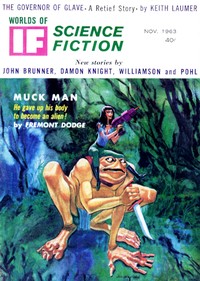
Muck Man — Text and Context
Space Future
9,404 recorded words. 0 minutes difference from this book's estimate.
View Gutenberg source #61467
Before opening The Castaway — Key Ideas to Explore, the edition data offers a quick orientation: 9,349 words, 41 min estimated reading time, and 1 detected text section.
The text analysis averages about 12.9 words per sentence, while the detected sections provide another way to judge how the source is divided.
Project Gutenberg metadata also associates the work with “Science fiction,” connecting these edition facts with the source record’s subject description.
Explore this collection
These alternatives are selected using recorded categories and estimated reading time.
About 41 minutes
Space Future
9,404 recorded words. 0 minutes difference from this book's estimate.
View Gutenberg source #61467About 40 minutes
Space Future
9,023 recorded words. 1 minutes difference from this book's estimate.
View Gutenberg source #61242About 42 minutes
Space Future
9,523 recorded words. 1 minutes difference from this book's estimate.
View Gutenberg source #61869Search stored excerpts and compare books → Choose by your preferences →
Choices use stored catalog measurements. Estimates vary with reading speed. A shared category is a catalog label, not a claim that two books have the same argument or literary quality.
Search reads excerpt text stored with this catalog and links to its associated Gutenberg record. The connection is stored in the site database; this tool does not recheck that every excerpt is word-for-word identical to that external record. Excerpt search does not cover every chapter and does not verify historical publication dates.
Catalog snapshot checked: 2026-09-25. Coverage: 99 public books, 99 available source excerpts.
Read the complete public-domain text at its original source.
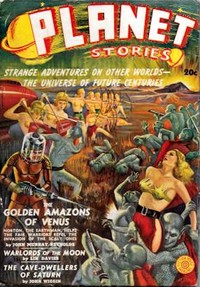
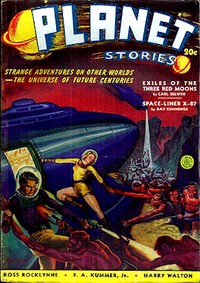
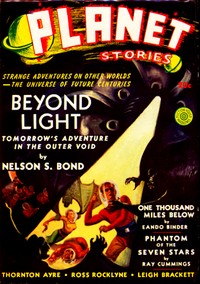
Read on Project GutenbergLieutenant Brait narrates this 1940 science fiction story from Planet Stories, beginning with a classified ad seeking Paul Moran—the very man his crew rescued from the asteroids. The opening establishes a conversational, jargon-rich voice: Brait chides radioman Toby Frisch for his spelling, and the ship's banter feels lived-in. The castaway's introduction is deliberately ambiguous: he is bearded, silent, and described with biblical overtones. The catalog subjects list 'Wandering Jew' alongside 'Castaways,' and the text soon confirms that connection, but the early pages withhold his identity, letting the mystery build through crew reactions.
The story's tone is set by Brait's first-person narration, which mixes technical space slang ('mekel-juice,' 'gobboon,' 'perilens') with casual insults. When Frisch protests, 'Leave my relatives out of this,' the dialogue feels natural, not expository. The crew's banter—'I'm a bug-pounder, not a joke-book'—grounds the high-concept premise in ordinary shipboard life. This vernacular contrasts sharply with the castaway's later, more archaic speech ('Death at last!'). The shift in register marks him as otherworldly, even before his true nature is revealed.
The catalog subject 'Wandering Jew' is explicitly invoked when Brait names the castaway 'John Cartaphilus'—a traditional alias for that figure. The excerpts show the crew oscillating between viewing him as a mad scientist ('one of Earth's greatest scientists') and a legendary being ('thousands of names'). His own words, 'What difference does a name make?' reinforce this ambiguity. The story does not resolve which interpretation is correct; instead, it uses both to heighten tension. The crew's desperation—trapped on a doomed trajectory—makes their need for his help urgent, yet his apparent longing for death undermines any easy redemption.
The plot hinges on a technical detail: the ship's trajectory is 'paper-thin, balanced on a knife-edge between counter-gravitations.' This is not generic space peril; it is a specific, engineered trap. The castaway deliberately forced the Antigone into this course, and the crew cannot deviate without destroying the ship. The excerpts show Chief Lester and Lieutenant Bartlett debating the physics, grounding the crisis in plausible (if fictional) mechanics. The countdown to the Heaviside layer creates a ticking clock, but the story's focus remains on character reactions—McNeally's pacing, Brait's bitterness, the castaway's eerie calm—rather than on action set-pieces.
Readers should pay attention to how the story balances its pulp adventure elements with a more philosophical undercurrent. The castaway's identity is never fully pinned down, and the excerpts leave his motives ambiguous. The narrative's strength lies in its tight focus on a single, escalating situation, told through a narrator who is both participant and observer. The ending is not included in the excerpts, so the resolution of the trajectory crisis—and the castaway's fate—remains open.
Reading about the crew’s growing unease on that asteroid, I remembered sitting on my porch years ago, turning pages of The Winning of the Moon — Inside the Classic, and feeling that same quiet dread—not of monsters, but of what isolation does to hope. Both books left me staring at the ceiling afterward, thinking about how we’re all a little stranded sometimes.
A brief reflection can help important ideas stay with you longer.