About 74 minutes
Cosmic Castaway — A Reader’s Guide
Other Worlds
16,827 recorded words. 12 minutes difference from this book's estimate.
View Gutenberg source #62319
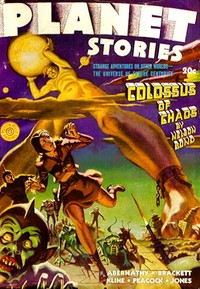
Colossus of Chaos — Edition Insights can be approached with a clearer sense of reading commitment from its source measurements: 19,636 words, 1 hr 26 min estimated reading time, and 2 detected text sections.
The text analysis averages about 11.6 words per sentence, while the detected sections provide another way to judge how the source is divided.
Project Gutenberg metadata also associates the work with “Science fiction,” connecting these edition facts with the source record’s subject description.
Explore this collection
These alternatives are selected using recorded categories and estimated reading time.
About 74 minutes
Other Worlds
16,827 recorded words. 12 minutes difference from this book's estimate.
View Gutenberg source #62319About 69 minutes
Other Worlds
15,785 recorded words. 17 minutes difference from this book's estimate.
View Gutenberg source #61978About 104 minutes
Other Worlds
23,785 recorded words. 18 minutes difference from this book's estimate.
View Gutenberg source #61859Search stored excerpts and compare books → Choose by your preferences →
Choices use stored catalog measurements. Estimates vary with reading speed. A shared category is a catalog label, not a claim that two books have the same argument or literary quality.
Search reads excerpt text stored with this catalog and links to its associated Gutenberg record. The connection is stored in the site database; this tool does not recheck that every excerpt is word-for-word identical to that external record. Excerpt search does not cover every chapter and does not verify historical publication dates.
Catalog snapshot checked: 2026-09-25. Coverage: 99 public books, 99 available source excerpts.
Read the complete public-domain text at its original source.
Read on Project GutenbergThe story opens with a description of an alien entity that is deliberately vague: "It was round, but not quite round; It was hard, but not altogether hard; It was cold, but not cold with the terrible, utter iciness of things which come from Beyond." This pattern of negation—defining by what something is not—establishes a tone of cosmic uncertainty. The entity is passive, carried by chance, until it finds a home on Titan, Saturn's sixth moon. The prose then pivots sharply to a domestic scene aboard the space-cruiser Gaea, where Captain Burke and a passenger discuss brandy with the same precision used for the alien. This juxtaposition of the ineffable and the mundane is a key structural choice.
Bond's language for the alien relies on paradox and approximation. Words like "frore," "petroid carapace," and "kinetic universe" create a scientific veneer, but the entity remains undefined. The repeated capitalization of "It" and "Its" grants the creature a quasi-religious weight, while phrases like "evil spawn of lifeless space" from the subtitle hint at malevolence without evidence. This diction avoids anthropomorphism; the alien does not think or feel—it merely exists and grows. The effect is a horror of the impersonal, where the threat is not malice but sheer otherness.
The human characters are introduced through dialogue that reveals social hierarchies. The heavy man's appreciation of "Domrémy-Thol '98" brandy establishes him as a connoisseur, but his repetition of "dangerous" foreshadows his role. Captain Burke's "self-satisfied complacency" contrasts with the later tension. In the confrontation scene, Rocky Russell's clipped, formal speech—"My name is Russell. Captain Russell of the S.I.D."—asserts authority, while Grossman's oily, taunting tone ("my dear Doctor") and his use of "protective custody" mark him as a manipulative antagonist. The dialogue carries the plot's exposition without relying on narrative summary.
Titan is described only in fragments: "deep, soft, sandy pit," "gray hoar-frost," and later "the sands" and "a low escarpment." The environment is harsh and alien, but Bond does not linger on landscape. Instead, the setting functions as a stage for human conflict. The alien's birthing-place is a "lair" in the sand, while the human drama unfolds in a ship's cabin or on a road. The lack of detailed world-building keeps focus on the entity and the power struggle. Notably, the alien's growth is tied to "sucking energy from Terra itself," linking setting to threat.
The narrative voice shifts between omniscient detachment and close third-person. The opening paragraphs are almost mythic in tone, with short, rhythmic sentences: "Out of the darkness It came." Once humans appear, the voice becomes more conventional, focusing on dialogue and action. The point of view stays with Rocky Russell during the confrontation, allowing the reader to share his limited knowledge. Grossman's revelation of an "ally powerful enough" hints at the alien's role, but the narrative withholds the entity's nature. This controlled perspective builds suspense without revealing the full picture.
Readers should note how Bond balances two registers: the cosmic horror of an unknowable entity and the pulp-adventure intrigue of a villain's scheme. The excerpts suggest the alien may be a weapon or a force that Grossman seeks to control, but the story's resolution is not given. Pay attention to how Bond uses the alien's passivity—its lack of motive—to create unease, while the human characters drive the plot through dialogue and confrontation. The interplay between these elements defines the novella's distinctive tone.
There’s something about that old Bond novella—the way Grossman’s schemes feel so small against Titan’s cold silence—that stays with me. It made me think of another quiet world, Star of Panadur — Key Ideas to Explore, where the human longing feels just as fragile against the stars. I still catch myself wondering which one haunts me more.
Your answers remain private and are stored only in this browser.