About 55 minutes
The Thing of Venus — Context and Discussion
Other Worlds
12,525 recorded words. 2 minutes difference from this book's estimate.
View Gutenberg source #62076
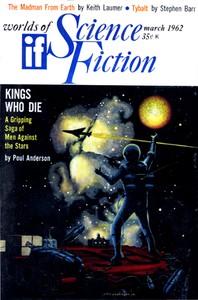
For The Madman From Earth — A Closer Reading, the stored edition analysis reports 12,132 words, 53 min estimated reading time, and 2 detected text sections.
The text analysis averages about 10.8 words per sentence, while the detected sections provide another way to judge how the source is divided.
Project Gutenberg metadata also associates the work with “Science fiction,” connecting these edition facts with the source record’s subject description.
Explore this collection
These alternatives are selected using recorded categories and estimated reading time.
About 55 minutes
Other Worlds
12,525 recorded words. 2 minutes difference from this book's estimate.
View Gutenberg source #62076About 51 minutes
Other Worlds
11,644 recorded words. 2 minutes difference from this book's estimate.
View Gutenberg source #62323About 55 minutes
Other Worlds
12,515 recorded words. 2 minutes difference from this book's estimate.
View Gutenberg source #63309Search stored excerpts and compare books → Choose by your preferences →
Choices use stored catalog measurements. Estimates vary with reading speed. A shared category is a catalog label, not a claim that two books have the same argument or literary quality.
Search reads excerpt text stored with this catalog and links to its associated Gutenberg record. The connection is stored in the site database; this tool does not recheck that every excerpt is word-for-word identical to that external record. Excerpt search does not cover every chapter and does not verify historical publication dates.
Catalog snapshot checked: 2026-09-25. Coverage: 99 public books, 99 available source excerpts.
Read the complete public-domain text at its original source.
Read on Project GutenbergFrom the opening lines, Keith Laumer's The Madman from Earth establishes a tone of bureaucratic farce undercut by physical threat. Retief, the Terrestrial consul on Groac, dictates a refusal to a cultural event while his assistant Meuhl overrides him, revealing a power struggle embedded in diplomatic niceties. The story quickly pivots from office politics to a car chase, with Retief commandeering a vehicle and threatening a Groacian security official. The excerpts show a narrative that alternates between satirical dialogue and violent action, with Retief's irreverence toward Groacian customs—such as interpretive grimacing—contrasting sharply with his willingness to use a scatter-gun. The catalog subjects list diplomacy and human-alien encounters, but the text emphasizes Retief's physicality and the Groaci's insectoid features (mandibles, eyestalks, carapace), grounding the conflict in embodied difference rather than abstract negotiation.
The excerpts open with a clash over a letter: Retief wants to decline an invitation to a recital of interpretive grimacing, but Meuhl insists on accepting. Meuhl's line—"I wrote them for you. They're just as Consul Whaffle would have wanted them"—reveals she has been ghostwriting official correspondence, effectively controlling the consulate's voice. Retief's response—"Did you write all Whaffle's letters for him, Miss Meuhl?"—turns the exchange into an interrogation of her authority. The power dynamic is reinforced by her physical description: "thick lenses" and a "dictyper" (a typewriter-like device). Retief's decision to cut out cultural events and visit the Foreign Office Archives signals a shift from passive diplomacy to active investigation, a move Meuhl resists by invoking Groacian sensitivity. This tension between bureaucratic inertia and individual initiative drives the early narrative, with Retief's cigar smoke and light cape marking him as a figure of casual defiance.
When Retief is captured by Groacian security, the prose shifts to rapid, physical action. He grabs Shluh by the throat, uppercuts a guard, and seizes a scatter-gun. The Groaci are described with insectoid features: mandibles, eyestalks, a carapace. Shluh's threat—"To burst your throat sac, evil-smelling beast!"—uses the Groacian verbal tic of starting sentences with "To," a stylistic marker that Laumer employs consistently. Retief's reply—"Sorry, I haven't got one"—underscores the anatomical difference. The car chase includes details like "the car bounded over the irregular surface of the road, puffing furiously" and "it blew off steam and sat trembling." Retief's method of control—threatening to toss Shluh out at high speed—is both pragmatic and darkly comic. The Groaci's helpless fury is conveyed through phrases like "grated his mandibles" and "swiveled a choleric eye," emphasizing their alien physiology while keeping the action legible.
The excerpts offer limited but vivid glimpses of Groac. The landscape includes "relief-crusted mounds" and "tilled fields," suggesting an agricultural world with unusual geology. The spaceport is a "military enclosure" with a "security fence" and "four slender ships" on the ramp. Retief's destination—the Foreign Office Archives—implies a history of suppressed information, particularly regarding a missing Terrestrial cruiser and a coup d'état. Meuhl's comment that "the Groaci are a very sensitive race" and her shame over past "high-handed tactics" hint at colonial tensions, but the excerpts do not reveal the cruiser's fate or the coup's details. The Groacian language is marked by the prefix "To" in commands, a stylistic choice that reinforces their alienness without becoming incomprehensible. The setting serves as a backdrop for Retief's improvisation, with the car chase and spaceport infiltration prioritizing momentum over exposition.
Readers should note that the excerpts cover only the first half of the novella, ending as Retief reaches the spaceport. The catalog subject "detective and mystery stories" is supported by Retief's investigation into the missing cruiser, but the excerpts emphasize action and satire over deduction. The Groacian verbal tic and Retief's physicality are consistent throughout the available text, suggesting a work that balances genre conventions with a distinctive authorial voice.
That rainy afternoon, Retief’s bluntness on Groac reminded me how often kindness hides inside rough edges. The novella’s satire lingered, but the quiet friction between protocol and honesty stayed with me. Later, almost without thinking, I reached for Aide Memoire — Story, Setting & Ideas, and found the same tender ache beneath its own careful surfaces.
Build a private reading journal entry for this title.