About 32 minutes
Threlkeld's Daughter — Reading Notes
Other Worlds
7,135 recorded words. 1 minutes difference from this book's estimate.
View Gutenberg source #61414
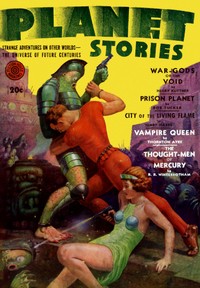
The Thought-Men of Mercury — A Reader’s Guide can be approached with a clearer sense of reading commitment from its source measurements: 7,385 words, 33 min estimated reading time, and 1 detected text section.
The text analysis averages about 13.3 words per sentence, while the detected sections provide another way to judge how the source is divided.
Project Gutenberg metadata also associates the work with “Science fiction,” connecting these edition facts with the source record’s subject description.
Explore this collection
These alternatives are selected using recorded categories and estimated reading time.
About 32 minutes
Other Worlds
7,135 recorded words. 1 minutes difference from this book's estimate.
View Gutenberg source #61414About 31 minutes
Other Worlds
7,051 recorded words. 2 minutes difference from this book's estimate.
View Gutenberg source #61048About 31 minutes
Other Worlds
6,916 recorded words. 2 minutes difference from this book's estimate.
View Gutenberg source #62253Search stored excerpts and compare books → Choose by your preferences →
Choices use stored catalog measurements. Estimates vary with reading speed. A shared category is a catalog label, not a claim that two books have the same argument or literary quality.
Search reads excerpt text stored with this catalog and links to its associated Gutenberg record. The connection is stored in the site database; this tool does not recheck that every excerpt is word-for-word identical to that external record. Excerpt search does not cover every chapter and does not verify historical publication dates.
Catalog snapshot checked: 2026-09-25. Coverage: 99 public books, 99 available source excerpts.
Read the complete public-domain text at its original source.
Read on Project GutenbergThe story opens with a striking sensory contrast: "It was neither night nor day, but a sort of nether world of twilight." This immediate dislocation establishes Mercury as a liminal battleground between "roasting heat and perpetual cold." The setting is not merely backdrop but an active constraint—a "twenty-mile strip of habitable land" that confines the characters physically and, as becomes clear, mentally. The first excerpt introduces the telepathic Mercurians through a "painless stab of thought," a phrase that economically conveys the alien threat: mind-reading without physical contact. This opening efficiently sets up the central problem—how to escape captors who can read every plan.
The perpetual twilight of Mercury is more than atmospheric; it mirrors the characters' cognitive predicament. Terry Hall's fear is described as "panic" that makes his hands slip from his weapon—a physical manifestation of mental paralysis. The ferns that "seemed to close in after Cappy Upjohn and Terry Hall like prison bars" visually echo the mind-reading threat: there is no privacy, no shadow for a thought. Cappy's bravado—"Scared!"—contrasts with Terry's admission that the place "gives me the creeps," but both are equally vulnerable. The setting thus functions as an externalized psychological state, where the environment and the alien telepathy reinforce each other. Readers should note how the landscape itself becomes an antagonist, narrowing options and amplifying tension.
Winterbotham uses telepathy not as a gimmick but as a structural limitation on plot. The Mercurians' mind-reading forces the characters to avoid forming plans: "don't act on any set plan. Don't plan what you'll do when you meet 'em." This rule creates a unique narrative tension where the protagonists must act on impulse, yet the story also questions whether impulse is reliable. Terry reflects that "man had made some strides by accident, but far more of his greatest discoveries... had been the result of years of labor and careful planning." The excerpts show a deliberate oscillation between spontaneous action and reasoned strategy, leaving unresolved which approach will ultimately prevail. This ambiguity is a key feature for first-time readers to track.
In the climactic excerpt, Terry faces Chomby, a Mercurian armed with a "flourobeam gun" capable of "complete annihilation." The standoff is a test of nerve: Terry advances despite Cappy's protests of "suicide." The dialogue shifts to a "war of the worlds" rhetoric, with Terry invoking "Waterloo" as a historical parallel. Notably, the story withholds the outcome—the excerpt cuts before the confrontation resolves. This incomplete climax is a deliberate narrative choice, forcing readers to infer the resolution from the story's internal logic. The flourobeam gun, described earlier as powerful enough to "wipe out a steel ball ten feet in diameter," raises the stakes but also introduces a potential Chekhov's gun: will it be used, or will a different weapon—perhaps the very impulse Terry questions—prove decisive?
The dialogue between Terry and Cappy reveals their dynamic through contrasting speech patterns. Cappy uses colloquial, dismissive language: "What the devil did you expect, Tenderfoot?" and "You've got guts!" Terry, by contrast, speaks in more measured, analytical terms, even in crisis: "This is a war of the worlds, Chomby." Their exchanges also carry the story's thematic weight. When Cappy says "The better part of valor is knowing when you're licked," he echoes a proverb that Terry rejects. The younger man's insistence on moving forward, despite the odds, suggests a generational or ideological divide. Readers should attend to how these voices carry the story's argument about courage, planning, and the nature of human superiority over the Mercurians.
As you read, note how Winterbotham balances the constraints of telepathy against the characters' need for agency. The Mercurians are never fully described beyond their "simian" appearance and telepathic ability—their interiority remains opaque. This asymmetry keeps the focus on the human protagonists' struggle. Pay attention to moments where the narrative explicitly comments on thought versus impulse, as these passages may foreshadow the story's resolution. The excerpts suggest a tight, focused narrative that uses its science-fictional premise to explore a practical problem: how to outthink an enemy who shares your every thought.
There is a particular quiet in Winterbotham’s Mercury, where telepathic hesitation meets hurried impulse—a twilight balance I’ve come to treasure. It reminds me of another shelf-friend, one that lingers on what remains when planning fails. Both share that hush between thought and action. All That Earthly Remains — A Closer Reading holds that same tender weight, like a familiar whisper from a neighboring volume.
Build a private reading journal entry for this title.