About 46 minutes
Men Without a World — Context and Discussion
Other Worlds
10,393 recorded words. 0 minutes difference from this book's estimate.
View Gutenberg source #63112
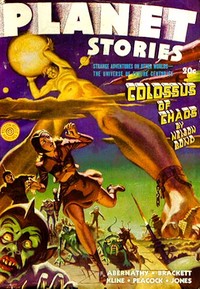
The source record for Planet of No-Return — A Closer Reading measures this digital text at 10,434 words, 46 min estimated reading time, and 2 detected text sections.
The text analysis averages about 16.1 words per sentence, while the detected sections provide another way to judge how the source is divided.
Project Gutenberg metadata also associates the work with “Science fiction,” connecting these edition facts with the source record’s subject description.
Explore this collection
These alternatives are selected using recorded categories and estimated reading time.
About 46 minutes
Other Worlds
10,393 recorded words. 0 minutes difference from this book's estimate.
View Gutenberg source #63112About 46 minutes
Other Worlds
10,368 recorded words. 0 minutes difference from this book's estimate.
View Gutenberg source #63523About 45 minutes
Other Worlds
10,198 recorded words. 1 minutes difference from this book's estimate.
View Gutenberg source #61890Search stored excerpts and compare books → Choose by your preferences →
Choices use stored catalog measurements. Estimates vary with reading speed. A shared category is a catalog label, not a claim that two books have the same argument or literary quality.
Search reads excerpt text stored with this catalog and links to its associated Gutenberg record. The connection is stored in the site database; this tool does not recheck that every excerpt is word-for-word identical to that external record. Excerpt search does not cover every chapter and does not verify historical publication dates.
Catalog snapshot checked: 2026-09-25. Coverage: 99 public books, 99 available source excerpts.
Read the complete public-domain text at its original source.
Read on Project GutenbergThe story opens with a shouting match inside a spaceship. Old Kerry Blane roars that he dislikes his young partner, the ship, the assignment, and the vitamin pills Splinter keeps eating. Splinter, lanky and amused, fires back with mock horror. The dialogue is fast, colloquial, and heavy with insults—Blane calls Wood a "squirt" and threatens to stuff his head down his throat. This bickering establishes a familiar pulp dynamic: the grizzled veteran versus the cocky kid. But the setting is unusual: a shielded ship en route to Venus, where no sunlight reaches the surface. The banter is punctuated by small physical details—capsules floating in zero gravity, a cigarette lit from a daily ration—that ground the scene in a specific, cramped spacecraft.
The catalog lists "Human-alien encounters" and "Adventure stories," but the excerpts reveal a more specific tension: the explorers are equipped with the wrong tools. After crash-landing, Kerry Blane reflects bitterly on the "stupid line of reasoning" that gave them dis-guns instead of weapons suited to Venus. The planet is a "Water-world," and the opening blurb warns that their weapons are useless there. This mismatch drives the action. When Blane faces a sand-dwelling snake-creature with a single malevolent eye, his dis-gun works—but only because the creature is small. Later, a carnivorous plant with rubbery creepers nearly kills him; only Splinter's shot from the ship saves him. The story repeatedly shows that the patrolmen cannot simply blast their way through the environment. Their survival depends on luck and teamwork, not firepower.
The catalog subject "Male friendship -- Fiction" is borne out by the excerpts, but the friendship is not sentimental. It emerges through conflict. Blane and Wood trade insults constantly—Blane calls Wood a "young squirt" and mocks his vitamins; Wood grins and teases back. Yet when Blane is trapped by the plant creeper, he screams for Splinter, and Splinter responds instantly, white-faced, blasting the plant. The rescue is wordless and efficient. Afterward, Blane downplays the danger with a gruff explanation, and Splinter, still pale, suggests they eat. The bond is shown through action and understatement, not declaration. The story uses their bickering to establish character, then lets the crisis reveal their reliance on each other. This pattern—conflict followed by cooperation—is typical of pulp duos, but Peacock executes it with brisk, specific dialogue.
The catalog subject "Venus (Planet) -- Fiction" is accurate, but the excerpts depict Venus not as a planet with cities or aliens, but as a wet, dangerous wilderness. The surface has "silvery sand," a forest edge, and an ocean. The threats are biological: a snake-creature that burrows, a plant that mimics a Venus flytrap on a giant scale. Blane feels watched but cannot see the watcher. The environment itself seems alive—tree fronds move "with an uncanny life," sand bulges as the creature emerges. Peacock uses sensory details: the "scraping sounds" of tiny legs, the "dank miasma" of charred flesh, the "bloody, sucking mouth" of the blossom. This is not a planet of ruins or exotic civilizations; it is a frontier of predatory flora and fauna, where the human intruders are prey. The story's title, "Planet of No-Return," hints that the landscape itself may be the true antagonist.
Readers should pay attention to the story's pacing: the opening argument runs several pages before the ship crashes, and the action scenes are brief but vivid. The excerpts end before the protoplasmic monster appears, so the full nature of the "THING" remains unknown. The story was originally published in Planet Stories (Winter 1942), a pulp magazine known for fast-paced adventure. Peacock's style favors dialogue and physical detail over exposition. The vitamin pills, the daily cigarette ration, and the dis-gun's limitations are small clues that build a coherent, if minimal, world. Approach this as a tight, character-driven survival tale rather than a sweeping space opera.
There’s something tender about that pulp Venus—the way Kerry and Splinter bicker like family while the planet itself shrugs off their weapons. It makes me think of Colossus of Chaos, another relic where the monsters outlast the men. I found that one years later, dust on the spine, and it felt like the same quiet ache: heroes so sure, worlds so indifferent. Colossus of Chaos — Edition Insights carries that feeling forward, gently.
Save your reaction, strongest insight, and memorable passage.