About 26 minutes
Treasure of Triton — A Closer Reading
Other Worlds
5,969 recorded words. 3 minutes difference from this book's estimate.
View Gutenberg source #61872
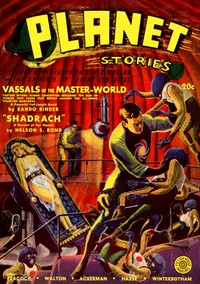
The Victory of Klon — Reading Companion can be approached with a clearer sense of reading commitment from its source measurements: 5,126 words, 23 min estimated reading time, and 1 detected text section.
The text analysis averages about 22.0 words per sentence, while the detected sections provide another way to judge how the source is divided.
Project Gutenberg metadata also associates the work with “Science fiction,” connecting these edition facts with the source record’s subject description.
Explore this collection
These alternatives are selected using recorded categories and estimated reading time.
About 26 minutes
Other Worlds
5,969 recorded words. 3 minutes difference from this book's estimate.
View Gutenberg source #61872About 27 minutes
Other Worlds
6,185 recorded words. 4 minutes difference from this book's estimate.
View Gutenberg source #63474About 28 minutes
Other Worlds
6,238 recorded words. 5 minutes difference from this book's estimate.
View Gutenberg source #61050Search stored excerpts and compare books → Choose by your preferences →
Choices use stored catalog measurements. Estimates vary with reading speed. A shared category is a catalog label, not a claim that two books have the same argument or literary quality.
Search reads excerpt text stored with this catalog and links to its associated Gutenberg record. The connection is stored in the site database; this tool does not recheck that every excerpt is word-for-word identical to that external record. Excerpt search does not cover every chapter and does not verify historical publication dates.
Catalog snapshot checked: 2026-09-25. Coverage: 99 public books, 99 available source excerpts.
Read the complete public-domain text at its original source.
Read on Project GutenbergThe story opens with Klon, a lidless-eyed, gilled creature, moving through a Venusian jungle where 'there were no colors on his earth' and shadows are merely 'two shades of blackness.' He is drawn to a gleaming object from the sky, which casts a shadow lighter than any he has seen. The narrative immediately establishes a sensory world defined by absence: no color, constant fog, and stagnant water covering nine-tenths of the planet. Klon's goal is to possess that 'light shadow,' believing it will make him 'greater than anyone else on the planet' and secure victory over his rival Valok.
Peacock's prose emphasizes physical discomfort and alien physiology: Klon winces at the hardness of burned ground, his sucker-discs aid his climb, and his gills work automatically. The encounter with the spaceship's window reveals 'nightmarish creatures'—humans—whose appearance is hideous to Klon, inverting the typical human-perspective alien encounter.
The setting is built on sensory deprivation. Venus is 'eternally-veiled,' with fog that never lifts and darkness that 'never changed.' The only light comes from phosphorescent gleams and the spaceship's glow. Klon's eye, described as 'lidless,' perceives the world in shades of blackness. This monochrome existence makes the spaceship's shadow—described as 'amazingly light' and 'without blackness'—a source of wonder and desire. The text repeatedly stresses the absence of color, a detail that shapes every description: the jungle, the water, even the creatures inside the ship are seen as 'shadows of their skins' in 'shades of light.' This limited palette creates a claustrophobic, alien atmosphere that contrasts sharply with the human reader's experience.
Klon's drive for power is palpable. He knows his time is short before a new leader is declared, and the light shadow is his only chance to surpass Valok. But his pursuit comes with physical pain: he feels 'tiny pains running through his eye, back into his head, and down into his body' when pressing against the window. The narrative does not shy away from the cost of his ambition. His body is ill-suited to the dry, hard ground of the clearing, and he moves with constant caution, 'ready for flight to safety.' This tension between desire and vulnerability makes Klon a sympathetic figure despite his alienness. The story suggests that leadership among his people is won through such risky, painful acts of courage.
Rather than humans discovering an alien world, Peacock presents an alien discovering humans. Klon's perspective is the primary lens. When he sees the human crew through the window, they are 'nightmarish creatures' with 'stiff tentacles' (arms), 'fanged mouths' (teeth), and 'sickening motions.' The familiar becomes grotesque. This inversion is a classic science-fiction technique, but Peacock executes it with specific, visceral detail: the humans' skin shadows are 'of shades of light,' a phrase that ties back to the story's color theme. The excerpt does not reveal what happens next, but the setup promises a conflict where the alien's victory may be ambiguous or tragic, given the subtitle: 'a deadly triumph for Klon.'
Readers should attend to how Peacock maintains Klon's point of view throughout, resisting the urge to switch to a human perspective. The story's tension hinges on whether Klon's 'victory' will be worth the physical and psychological cost. The limited excerpt leaves the outcome uncertain, but the careful world-building—especially the motif of light and color—suggests a payoff that redefines what triumph means in a world without light.
Sometimes a story stays because it's not about winning, but about what we mistake for light in the fog. Klon’s colorless world made me think of how we all reach for something bright without knowing its shape. Alien Equivalent — Edition Insights felt like a quiet echo of that same ache, a gentle companion to the strange, persistent longing Peacock captured. I kept turning it over long after closing the page.
Answer a few questions and save a private reflection on this device.