
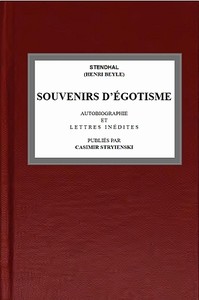
Souvenirs d'égotisme by Stendhal
Stendhal, the pen name for Marie-Henri Beyle, wrote this candid personal notebook over a couple of months in 1832. He was nearly fifty, living in what he saw as the boring political backwater of Civitavecchia as a French consul, and feeling utterly forgotten by the Parisian literary world. The 'souvenirs' or 'memories' he jots down aren't a linear life story. Instead, they're a series of sharp, often self-critical snapshots from his time in Paris a decade earlier.
The Story
There's no traditional plot. The 'story' is the unfolding of Stendhal's own mind. He recounts awkward social encounters, analyzes his failed romantic pursuits, and dissects his envy of more successful writers. He writes with the goal of painting a true psychological portrait for some future reader he imagines will understand him around 1880 or 1900. He details his strategy of using 'logic' to navigate salons and love affairs, a tactic that usually backfires. The narrative jumps from a witty observation about a duchess to a pitiful account of his loneliness, creating a compelling and deeply human mosaic of a man who is both incredibly perceptive and painfully self-conscious.
Why You Should Read It
What grabbed me was how modern Stendhal's inner voice feels. His 'egotism' isn't arrogance—it's that exhausting, hyper-aware self-analysis we all recognize. When he writes about pretending to be cold to hide his shyness, or calculating every word in a conversation, it’s like reading a diary from a friend who overthinks everything. It’s also darkly funny. His honesty about his own pettiness and social blunders is disarming. You're not reading about a marble statue of a Great Author; you're getting the messy, vulnerable person behind the books. It completely changed how I see his famous novels, knowing the raw material of anxiety and observation they came from.
Final Verdict
This is a perfect, short read for anyone who loves personality-driven writing, diarists like Samuel Pepys or Anaïs Nin, or fans of Stendhal's novels who want to meet the man behind them. It’s not for readers who need a strong plot or a heroic figure. But if you're fascinated by psychology, the creative process, or just enjoy a brilliantly honest and somewhat neurotic companion for an afternoon, this book is a hidden gem. Think of it as the 19th century's most insightful blog post.
This content is free to share and distribute. Use this text in your own projects freely.
Matthew Brown
6 months agoVery helpful, thanks.
Liam Hernandez
1 year agoSimply put, the storytelling feels authentic and emotionally grounded. Don't hesitate to start reading.
Joseph Williams
1 year agoWithout a doubt, the author's voice is distinct and makes complex topics easy to digest. Highly recommended.
Ethan Nguyen
2 years agoClear and concise.




Christopher Brown
2 years agoAfter hearing about this author multiple times, the depth of research presented here is truly commendable. Definitely a 5-star read.