
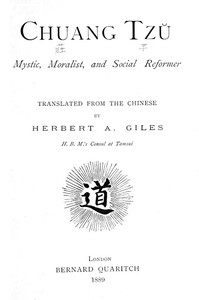
Chuang Tzu: Mystic, Moralist, and Social Reformer by Zhuangzi
Forget everything you think you know about ancient philosophy. Chuang Tzu (or Zhuangzi) isn't about lists of rules or dry arguments. It's a series of stories, jokes, and mind-bending conversations that feel more like a surreal podcast than a textbook. The 'plot' is loose—it's really just Zhuangzi and his friends (including butchers, cicadas, and skulls) chatting about the big questions. They debate by telling fables about giant fish that turn into birds, skilled craftsmen who work in a trance, and men who wonder if they're butterflies dreaming of being human.
The Story
There isn't one linear story. Instead, the book is a journey through Zhuangzi's worldview. We follow him as he rejects a high-ranking government job, preferring to 'drag his tail in the mud' like a turtle. We see him mourn his wife's death by drumming on a pot and singing, finding a strange joy in the natural cycle of things. The 'conflict' is between the artificial world of human striving—social status, rigid morality, endless debate—and the effortless, spontaneous flow of the natural world, which he calls the Dao. The book argues that our constant effort to control, label, and improve things is what actually makes us miserable.
Why You Should Read It
I picked this up on a whim and it completely reshaped my brain. In an age of hustle culture and optimization, Zhuangzi is the ultimate antidote. His celebration of 'uselessness' isn't about laziness; it's about finding value outside a system that only sees productivity. The parable of the crooked tree, spared by the lumberjack because its wood is good for nothing, hit me hard. It's about preserving what makes you unique, even if the world doesn't have a box for it. The writing is playful and deeply funny—he mocks other philosophers, pokes fun at Confucius, and isn't afraid to be absurd to make a point. It doesn't just make you think; it makes you see the world differently.
Final Verdict
This book is perfect for anyone feeling burned out by modern life's pressures, for creative types who feel blocked, or for readers who love philosophy but find most of it too stiff. It's also great for fans of existential or absurdist literature—think of it as the Eastern cousin to Albert Camus, but with more talking animals. Don't try to understand every line on the first read. Let the stories wash over you. Some will confuse you, some will make you laugh, and a few might just change how you live. Keep it on your nightstand and read a page whenever the world feels too serious.
No rights are reserved for this publication. You are welcome to share this with anyone.
Elizabeth Taylor
7 months agoThis was exactly the kind of deep dive I was searching for, the historical context mentioned in the early chapters is quite enlightening. A trustworthy resource that I'll keep in my digital library.
Robert Harris
11 months agoI've gone through the entire material twice now, and the argument presented in the middle section is particularly compelling. Finally, a source that prioritizes accuracy over hype.
John Thomas
8 months agoComparing this to other titles in the same genre, the clarity of the writing makes even the most dense sections readable. It’s a comprehensive resource that doesn't feel bloated.
George Lee
1 year agoLooking at the bibliography alone, the quality of the diagrams and illustrations (if applicable) is top-notch. It’s a comprehensive resource that doesn't feel bloated.
Jessica Thomas
3 months agoI decided to give this a try based on a colleague's recommendation, the chapter on advanced strategies offers insights I haven't seen elsewhere. The insights gained here are worth every minute of reading.