
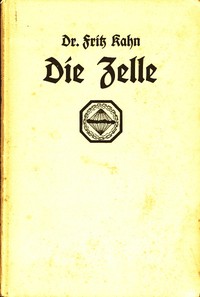
Die Zelle by Fritz Kahn
Published in the 1920s, Die Zelle (The Cell) isn't a story with characters in the usual sense. Its main character is you—or more precisely, the incredible microscopic world inside you. Fritz Kahn, a German doctor, faced a big problem: how do you explain complex biology to people who can't see cells? His brilliant solution was to use metaphors everyone understood: machines and factories.
The Story
Think of this book as a guided tour of a human body reimagined as a bustling industrial city. Kahn walks you through each system. Your digestive tract becomes a food processing plant with conveyor belts and chemical vats. Your lungs are compared to a ventilation system. Your brain is a central telephone exchange, with neurons as operators frantically connecting calls. The 'plot' is the journey of how raw materials (food, air) enter this complex and get transformed into energy, thought, and life itself. Kahn breaks down intimidating scientific processes into familiar, mechanical steps, making the invisible world inside us feel tangible and logical.
Why You Should Read It
What grabbed me wasn't just the clever comparisons, but the stunning art. The illustrations are where Kahn's ideas truly come alive. They're detailed, sometimes chaotic drawings of tiny men in overalls operating pumps in the heart or sorting molecules in the liver. It's a beautiful and bizarre mix of science, art, and imagination. Reading it today, you get a double insight: you learn basic physiology (which still holds up surprisingly well), and you also get a window into the early 20th-century mind. You see how people of that era used the technology they knew—gears, levers, switchboards—to grasp the biological unknown. It's a powerful reminder that how we visualize science shapes how we understand it.
Final Verdict
This book is perfect for curious minds who love where science, history, and art collide. If you're a fan of infographics, vintage design, or unconventional science writing, you'll be fascinated. It's also great for anyone who finds standard biology textbooks dry—this is the complete opposite. While some scientific details are naturally dated, the core creative achievement is timeless. Die Zelle is less of a strict textbook and more of an inspired, visual love letter to the hidden wonders of the human body, made by a guide who wanted everyone to share in the amazement.
This digital edition is based on a public domain text. It serves as a testament to our shared literary heritage.
George Jackson
1 year agoIt effectively synthesizes complex ideas into a coherent whole.
William Garcia
10 months agoIt’s refreshing to see such a high standard of digital publishing.
John Anderson
11 months agoExactly what I was looking for, thanks!
George Miller
1 year agoIt’s rare to find such a well-structured narrative nowadays, it addresses the common misconceptions in a very professional manner. I'll be citing this in my upcoming project.

Michael Lopez
1 year agoThis was exactly the kind of deep dive I was searching for, the logic behind each conclusion is easy to follow and verify. Top-tier content that deserves more recognition.