
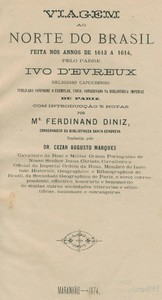
Viagem ao norte do Brazil feita nos annos 1613 a 1614, pelo Padre Ivo D'Evreux
So, what's this book actually about? In 1613, Father Yves d'Evreux sailed from France to the colony of Maranhão in northern Brazil. His mission, backed by the French crown, was clear: live among the Tupinambá people, learn their language, and bring them into the Catholic faith. His journal chronicles two intense years of that effort.
The Story
The book isn't a novel with a traditional plot, but the journey itself is the story. We follow Yves as he lands in São Luís, ventures into indigenous villages, and tries to build trust. He describes everything in vivid detail: the construction of longhouses, complex rituals, hunting practices, and even the preparation of manioc flour. The "action" comes from cultural clashes and negotiations. He witnesses ceremonies that baffle him, engages in long theological debates through translators, and navigates the fragile alliances between French settlers and powerful Tupinambá chiefs. There are moments of genuine connection and profound misunderstanding, all recorded with a sincerity that pulls you right into the heart of the 17th-century Amazon.
Why You Should Read It
What makes this book special is Father Yves's voice. He's not a distant, all-knowing narrator. He's a man out of his depth, constantly surprised. You get his frustration when his messages don't land, his awe at the Tupinambá's knowledge of the forest, and his palpable loneliness. He's a product of his time, so his goal is conversion, but his writing often reveals a reluctant respect for the people he's trying to change. Reading it, you're not just getting a list of facts about early Brazil; you're getting inside the head of someone living a monumental cultural experiment. It's this personal, conflicted, and observant lens that turns a historical document into a compelling human story.
Final Verdict
This is not a breezy beach read. It's for the curious reader who loves primary sources and real adventures. It's perfect for history buffs who want to move beyond textbooks, for anyone fascinated by first-contact stories, or for readers who enjoy travelogues from eras when maps still had blank spaces. If you liked the personal journey in Álvar Núñez Cabeza de Vaca's chronicles or the ethnographic detail in early Jesuit relations, you'll find a kindred spirit in Father Yves. Be prepared for the pace and perspective of a 17th-century diary, but if you settle into its rhythm, it offers an unforgettable glimpse into a pivotal moment of encounter.
This digital edition is based on a public domain text. Preserving history for future generations.
Joseph Perez
7 months agoAfter spending a few days with this digital edition, the formatting on mobile devices is surprisingly crisp and clear. Highly recommended for those seeking credible information.
Donald Smith
5 months agoAs a long-time follower of this subject matter, the way it challenges the status quo is both daring and well-supported. It’s a comprehensive resource that doesn't feel bloated.
Linda Miller
1 year agoHaving read the author's previous works, it addresses the common misconceptions in a very professional manner. It’s hard to find this much value in a single source these days.
Kimberly Taylor
3 months agoClear, concise, and incredibly informative.





Karen Miller
5 months agoThis digital copy caught my eye due to its reputation, the quality of the diagrams and illustrations (if applicable) is top-notch. This adds significant depth to my understanding of the field.