
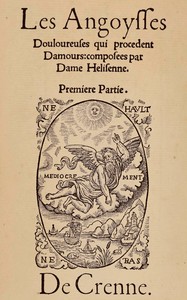
Les angoysses douloureuses qui procedent damours by Hélisenne de Crenne
Let's get the basics out of the way. This is often called the first sentimental novel in French, written by a woman using a version of her own name, which was incredibly bold for 1538. The book is split into three parts. It starts as a first-person story where Hélisenne, our narrator, tells us about her respectable marriage and then her sudden, overwhelming passion for a young knight named Guenelic. This isn't a sweet romance. It's an all-consuming obsession that throws her into a war between her duty and her desires.
The Story
The first part is pure emotional turmoil. We're right there with Hélisenne as she writes secret letters, arranges risky meetings, and spirals into jealousy and despair. Her husband finds out, locks her in a tower to 'cure' her, and things get dark. The second and third parts shift a bit, following Guenelic and his friend on a chivalric quest to find her, filled with allegorical adventures. But the heart of the book is that first section. It's the relentless, claustrophobic account of a smart woman watching herself make 'bad' choices and analyzing every painful second of it.
Why You Should Read It
What blew me away was the voice. Hélisenne de Crenne doesn't ask for our pity or judgment. She just lays it all out—the longing, the shame, the defiance. Reading it, you forget it's nearly 500 years old. The emotions are so immediate. It’s a powerful look at a woman trying to claim her own story and her own desire in a world that gave her no room for either. She uses her education to defend her right to feel, and that intellectual fire mixed with raw feeling is fascinating. It’s less a love story and more a survival story of the inner self.
Final Verdict
This isn't a light read, but it's a short and gripping one. Perfect for anyone interested in the roots of the novel, early feminism, or just unforgettable character studies. If you like complex, flawed narrators like in ‘The Tenant of Wildfell Hall’ or the intense interiority of a Sylvia Plath poem, you'll find a kindred spirit in Hélisenne. It's for the reader who wants to time-travel not to see castles and kings, but to hear a real, complicated human voice speaking across the centuries.
This digital edition is based on a public domain text. Distribute this work to help spread literacy.
Christopher Jackson
11 months agoThis digital copy caught my eye due to its reputation, the author’s unique perspective adds a fresh layer to the discussion. Thanks for making such a high-quality version available.
William Hernandez
8 months agoI found the author's tone to be very professional yet accessible, the visual layout and supporting data make the reading experience very smooth. I’ll definitely be revisiting some of these chapters again soon.
Mary Anderson
4 months agoIf you're tired of surface-level information, the transition between theoretical knowledge and practical application is seamless. A refreshing and intellectually stimulating read.
Ashley White
5 months agoI started reading this with a critical mind, the historical context mentioned in the early chapters is quite enlightening. Highly recommended for those seeking credible information.





Thomas Garcia
11 months agoI appreciate how this edition approaches the core problem, the footnotes provide extra depth for those who want to dig deeper. If you want to master this topic, start right here.