
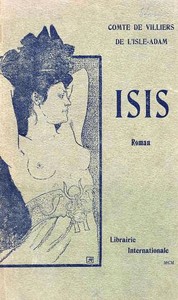
Isis: Roman by comte de Auguste Villiers de L'Isle-Adam
Let's be clear from the start: 'Isis' is a weird book. Written in the 1860s by a French count obsessed with the occult and symbolism, it feels like it teleported from another dimension of literature. It's not a fast-paced adventure. Instead, it's a slow, gorgeous, and sometimes frustrating portrait of a singular mind.
The Story
The plot is simple on the surface. In Imperial Rome, we meet Tullia Fabriana. She's not a damsel in distress; she's the opposite. Wealthy, educated, and breathtakingly intelligent, she views the world—its politics, its passions, its art—as childish games. Two men love her: a straightforward military man and a sensitive, poetic sculptor. But Tullia isn't interested in romance. She's on a solitary mission for absolute, divine wisdom. She wants to become like the goddess Isis, a being of pure intellect and will, free from all human frailty. The story watches her methodically strip away every earthly attachment in her pursuit of this impossible ideal.
Why You Should Read It
I loved this book for its sheer audacity. Tullia is one of the most fascinating and icy heroines I've ever encountered. She's not 'likable' in a traditional sense, but you can't look away. The book asks tough questions: Is there a point where genius becomes monstrous? Can we be too perfect? Villiers writes in lush, detailed prose that paints Rome not as a bustling city, but as a beautiful, silent museum. The atmosphere is everything—it's heavy, dreamlike, and full of symbolic meaning. Reading it feels like solving a puzzle. You're not just following events; you're trying to understand Tullia's grand, terrifying design.
Final Verdict
This is a niche book, and that's okay. It's perfect for readers who love atmospheric, idea-driven stories. Think of it as a companion to Mary Shelley's 'Frankenstein'—another tale about the dangers of pursuing knowledge without humanity. If you need constant action or a warm, fuzzy ending, look elsewhere. But if you're in the mood for a short, challenging, and visually stunning dive into a unique character's psyche, 'Isis' is a hidden treasure. It's for the patient reader who doesn't mind a book that lingers in your thoughts long after the last page.
This publication is available for unrestricted use. Access is open to everyone around the world.
Jennifer White
10 months agoThis digital copy caught my eye due to its reputation, it manages to maintain a consistent flow even when discussing difficult topics. Finally, a source that prioritizes accuracy over hype.
Christopher Brown
8 months agoAs a professional in this niche, the cross-referencing of different chapters makes it a great study tool. I'll be citing this in my upcoming project.





Donald Johnson
8 months agoI was skeptical about the depth of this book at first, but the author doesn't just scratch the surface but goes into meaningful detail. I feel much more confident in my knowledge after finishing this.