
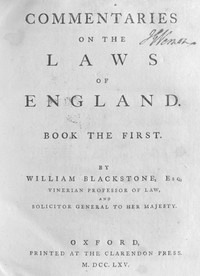
Commentaries on the Laws of England, Book the First by Sir William Blackstone
Let's be clear: this isn't a novel. There's no protagonist in the traditional sense, unless you count the English legal system itself. Sir William Blackstone's Commentaries is his monumental attempt to do something nobody had done before—take the entire, sprawling, confusing body of English common law and explain it in a way that ordinary, educated people could understand.
The Story
The 'plot' is the organization of ideas. Book the First is all about the rules for people—what Blackstone calls the 'Rights of Persons.' He starts with the biggest concept: absolute rights, like personal security and liberty, which he argues are given by nature. Then, he works his way down through the structure of society. He explains the rights of the monarch, the role of Parliament, and the duties of citizens. He gets into the nitty-gritty of different social ranks, from clergy to professionals to everyday folks. He even details the specific laws around master-servant relationships, husband and wife, and parent and child. The journey is from the broad, philosophical foundation of rights down to the specific rules that governed daily life in 18th-century England.
Why You Should Read It
You should read it not for plot twists, but for the sheer force of the thinking. It's like watching an architect draw up the blueprints for a world we now live in. When Blackstone lays out his famous principle that 'it is better that ten guilty persons escape, than that one innocent suffer,' you feel the weight of that idea being cemented into place. His writing has a confident, almost elegant rhythm as he sorts through history. You get a real sense of a man trying to build a coherent system out of a mountain of tradition and precedent. It’s surprisingly accessible for what it is—he was a teacher, and it shows. You come away understanding not just a list of old laws, but why he thought they mattered and how they fit together to protect (or sometimes fail to protect) the people living under them.
Final Verdict
This book is perfect for history buffs, law students looking for context, or any curious reader who has ever wondered where our modern ideas about justice and legal rights actually came from. It's not a beach read, but it is a profoundly satisfying brain workout. Think of it as visiting the foundation of a grand building. You might not want to live down there, but seeing the strength and thought in those original stones helps you appreciate everything built on top. Approach it slowly, a chapter at a time, and you'll be rewarded with a deeper understanding of the legal world we still navigate today.
No rights are reserved for this publication. It is now common property for all to enjoy.
Sandra Smith
1 year agoFive stars!
Kenneth Davis
1 year agoVery helpful, thanks.
Nancy Young
4 months agoHigh quality edition, very readable.
Joshua Brown
1 year agoFinally found time to read this!






Patricia Jones
2 years agoI stumbled upon this title during my weekend research and the bibliography and references suggest a high level of research and authority. I am looking forward to the author's next publication.